

Key Takeaways
- People with OCD often experience an uncontrolled urge to carry out compulsions or repetitive behaviours to reduce anxiety caused by obsessive thoughts.
- OCD involves persistent unpleasant or unwanted thoughts that can become distressing and difficult to ignore.
- At first, many people are not fully aware of their behavioural patterns until a mental health professional carries out an official assessment and diagnosis.
- OCD can affect daily routines, relationships, work, education, sleep, and emotional wellbeing.
- Compulsions may provide temporary relief, but the anxiety and obsessive thoughts often return, continuing the cycle.
- OCD symptoms can range from mild to severe and may become more overwhelming over time without the right support or treatment.
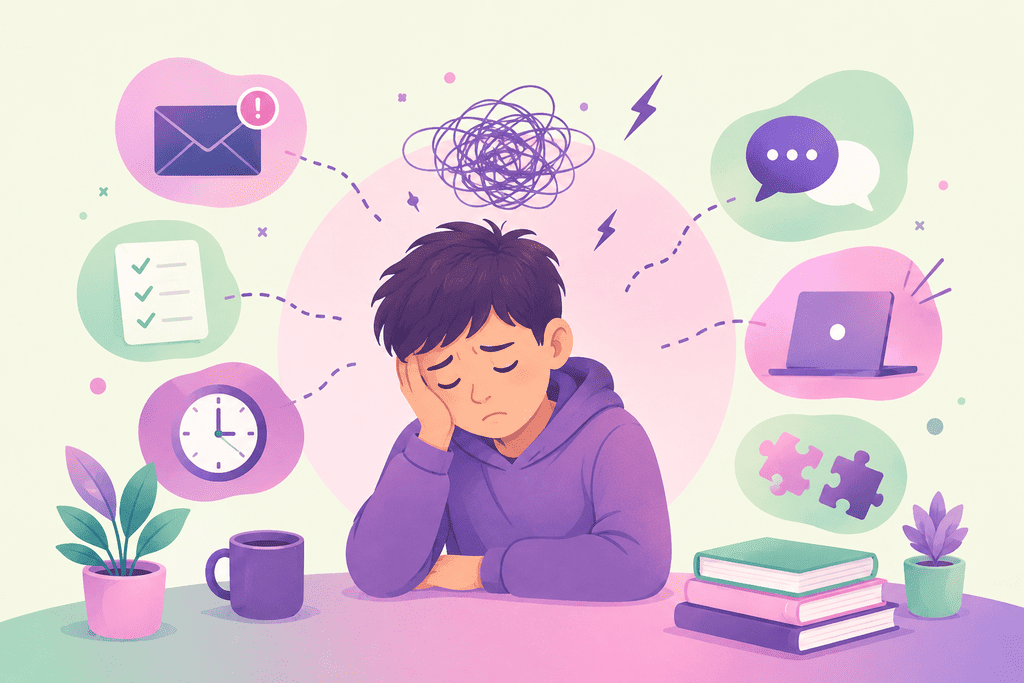
Sometimes, living with OCD means spending years fighting invisible battles in silence, smiling in conversations while our mind is stuck in fear, doubt, guilt, or panic.
OCD is a mental health condition that can affect people of all ages and can impact daily life and functioning. OCD is not a personality trait, and it involves deep brain stimulation that results in obsessive thoughts and behaviours around a range of things and activities.
Defining OCD
Based on the ICD-10 classification, Obsessive-Compulsive Disorder (OCD) is a mental health condition where a person experiences ongoing intrusive thoughts, fears, or urges (obsessions), alongside repetitive behaviours or mental rituals (compulsions) carried out to relieve anxiety or distress.
For many people, OCD can feel like being stuck in a cycle of fear, doubt, and mental exhaustion that is difficult to switch off.
People with lived experience explain that OCD is like an iceberg, where only a small part can be seen by others. The true struggles, fears, emotions, and mental challenges people deal with daily remain hidden from everyone else, and that’s the scariest part.
What Does OCD Feel Like
OCD can feel like being forced to face your worst fears every single day. A constant cycle of trying to fix, prevent, understand, or gain certainty over thoughts that feel deeply frightening, disturbing, or impossible to ignore. Every time one fear feels “resolved”, another quickly takes its place, leaving the mind in a near-constant state of anxiety, guilt, frustration, and exhaustion.
It can feel like living with relentless doubt – questioning thoughts, feelings, memories, intentions, and even the things and people that matter most. Many people recognise that the fears feel irrational, yet the obsession still feels painfully real, making the urge to check, analyse, avoid, repeat, or seek reassurance incredibly difficult to resist.
At Nurseline Community Services, our therapy team specialises in recognising, understanding, and supporting the traits and challenges experienced by people living with OCD.
OCD Symptoms
Obsessive-Compulsive Disorder (OCD) affects people in different ways, but it commonly involves a cycle of intrusive thoughts, anxiety, and repetitive behaviours or mental rituals used to reduce distress. Symptoms can range from visible compulsions to constant internal mental exhaustion that other people may never notice.
Many people with OCD are aware that their fears or behaviours may seem irrational, yet the anxiety and need for certainty can feel overwhelming and difficult to control. Symptoms may change over time, shift between themes, or become more intense during periods of stress, uncertainty, or major life changes.
OCD symptoms are generally grouped into two main categories: obsessions and compulsions.
A common and significant trait of OCD is the persistent feeling of intense anxiety, often even when there seems to be no clear reason for it.
Obsessions
Obsessions are unwanted thoughts, fears, urges, or mental images that repeatedly enter the mind and create distress, anxiety, guilt, or doubt.
- Unwanted intrusive thoughts, fears, or mental images
- Fear of contamination, harm, mistakes, or losing control
- Constant doubt and “what if” thinking
- Disturbing thoughts that go against personal values or identity
- Fear that something bad will happen to you or others
- Need for certainty, reassurance, or things to feel “just right”
- Repetitive overthinking that feels impossible to switch off
Compulsions
Compulsions are repetitive actions or mental acts used to reduce anxiety, prevent something feared from happening, or create a temporary sense of relief or certainty.
- Repeated checking (doors, locks, messages, appliances, health symptoms)
- Excessive cleaning, washing, or avoiding contamination
- Mental rituals such as counting, repeating words, reviewing memories, or praying
- Seeking reassurance from people or online searches
- Arranging, organising, or repeating actions until they feel “right”
- Avoiding situations, people, or objects linked to fears
- Repeating behaviours to temporarily reduce anxiety or guilt
The OCD Cycle
OCD often follows a repeating cycle where intrusive thoughts create distress, compulsions provide short-term relief, and the anxiety eventually returns again.
- Obsession or intrusive thought appears
- Anxiety, fear, guilt, or distress increases
- Compulsion or ritual is used to reduce the feeling
- Temporary relief follows
- The obsession returns – often stronger or attached to a new fear
- The cycle repeats again and again
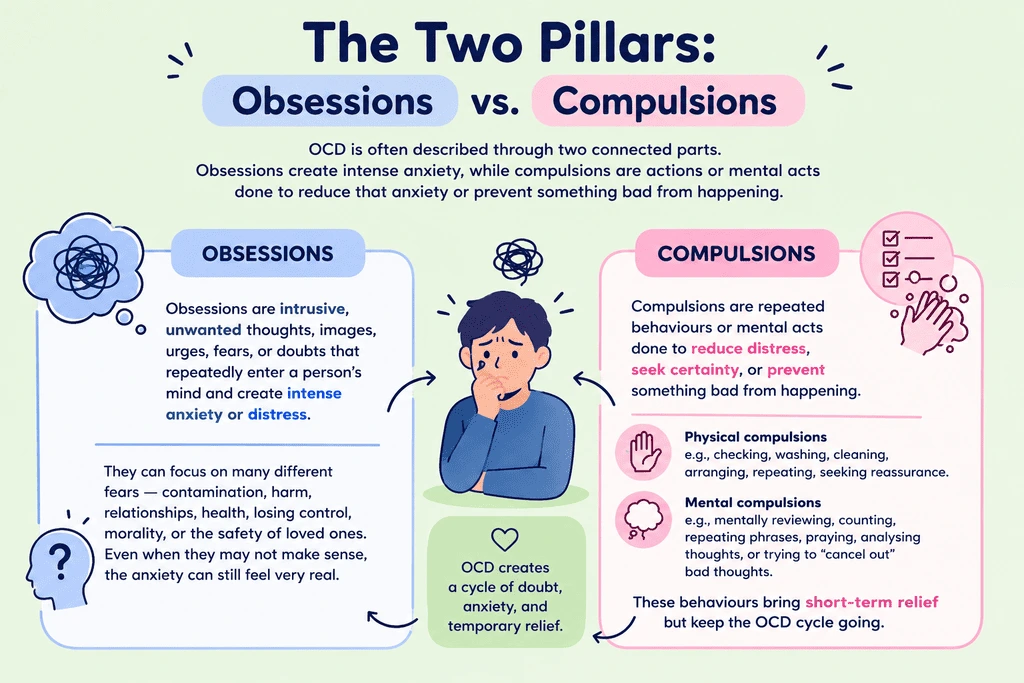
The Two Pillars: Obsessions vs. Compulsions
Obsessive-Compulsive Disorder (OCD) is often described through two connected parts: obsessions and compulsions. Obsessions create intense anxiety, fear, doubt, or distress, while compulsions are the actions or mental acts people feel driven to do in an attempt to reduce that anxiety or prevent something bad from happening.
- Obsessions are intrusive, unwanted thoughts, images, urges, or fears that feel difficult to ignore or control.
- Compulsions are repeated behaviours or mental acts carried out to relieve distress, feel “certain,” or prevent feared outcomes – even when the person knows the fear may not make logical sense.
What are Obsessions?
Obsessions are intrusive and unwanted thoughts, images, urges, fears, or doubts that repeatedly enter a person’s mind and create intense anxiety or distress. They are not simply “overthinking” or everyday worries. For many people with OCD, obsessions can feel deeply personal, frightening, or completely against their values, which is often what makes them so distressing.
These thoughts can focus on many different fears – contamination, harm, relationships, morality, health, losing control, religion, or the safety of loved ones. Even when someone recognises that the fear may be irrational or exaggerated, the anxiety can still feel very real. OCD often traps people in a constant cycle of doubt, making it difficult to feel fully certain, reassured, or “safe enough” to let the thought go.
What are Compulsions?
Compulsions are repeated behaviours or mental acts that a person feels driven to do in response to obsessive thoughts and the anxiety they create. The purpose of compulsions is usually to reduce distress, seek certainty, prevent something bad from happening, or temporarily relieve fear. For a short moment, they may bring relief – but the cycle quickly returns.
Compulsions are not always visible. Some people experience physical compulsive behaviours such as excessive checking, washing, cleaning, arranging, repeating actions, or seeking reassurance from others. Others experience mental compulsions, including mentally reviewing conversations, counting, repeating phrases, praying, analysing thoughts, or trying to “cancel out” bad thoughts with good ones.
Over time, such compulsive behaviour can become exhausting, time-consuming, and difficult to resist, even when the person knows it is affecting daily life.
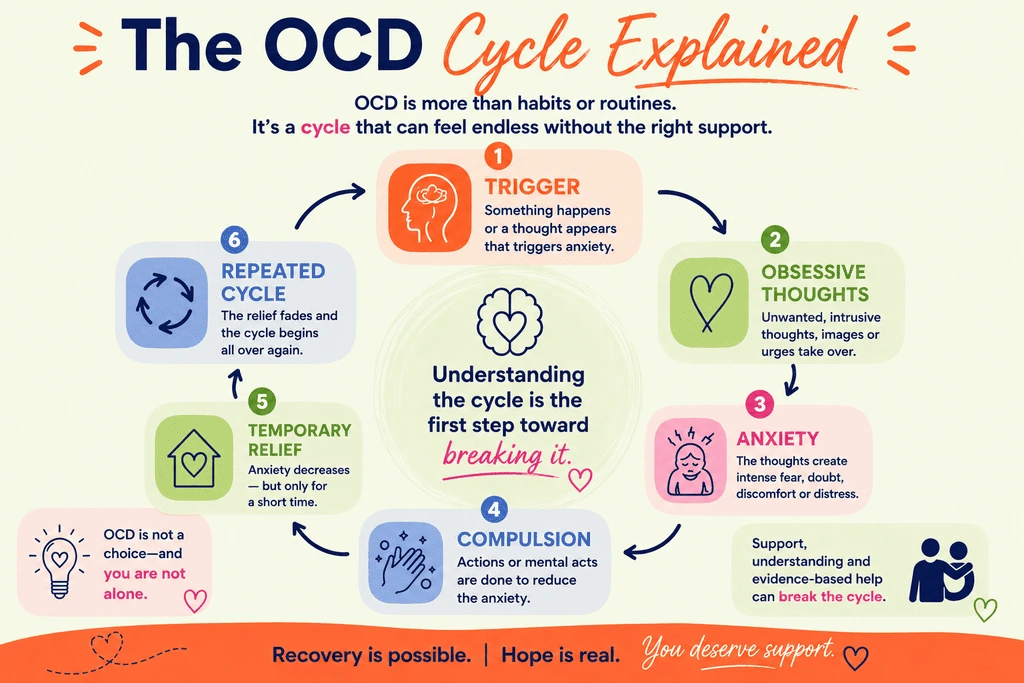
The OCD Cycle Explained
Obsessive-Compulsive Disorder (OCD) is part of a group of anxiety disorders where unwanted thoughts, fears, or images can become overwhelming and difficult to ignore. The cycle often begins with a trigger – this could be a thought, memory, feeling, situation, object, or even something completely ordinary in daily life. For many people, the trigger creates intense anxiety, distress, guilt, fear, or uncertainty. The mind then becomes stuck on obsessive thoughts that feel urgent, threatening, or impossible to let go of, even when the person knows they may not make logical sense.
To try to reduce that anxiety, compulsions begin. These can be visible actions such as checking, cleaning, repeating, arranging, seeking reassurance, or avoiding certain situations. They can also be mental acts, including counting, replaying conversations, mentally reviewing events, praying, or trying to “cancel out” bad thoughts. The compulsion may bring temporary relief, but it does not last. Instead, the brain learns that the compulsive behaviour reduces the anxiety, which strengthens the urge to repeat it again the next time fear appears.
Over time, this creates a repeated cycle: trigger → obsessive thoughts → anxiety → compulsion → temporary relief → obsessive thoughts again. What makes OCD exhausting is that the cycle keeps returning, often attaching itself to new fears, new doubts, or new situations. Many people with OCD describe feeling trapped in a constant loop of anxiety and control, where everyday moments can quickly become emotionally overwhelming.
Common Types of OCD
Obsessive Compulsive Disorder (OCD) can affect people in very different ways. Some people experience visible compulsions such as checking, cleaning, or arranging things repeatedly, while others struggle mostly with distressing intrusive thoughts that stay hidden from people around them. OCD is also closely linked with anxiety, shame, guilt, and other mental health problems such as depression, panic attacks, eating disorders, or Body Dysmorphic Disorder (BDD). Severe OCD can take over daily life, affecting relationships, work, sleep, concentration, and even simple everyday routines.
Many people with OCD are fully aware that their fears or thoughts may seem irrational, but the anxiety feels so real and overwhelming that resisting compulsions can feel almost impossible. Symptoms can also change over time, with one obsession fading and another taking its place.
- Contamination OCD – Fear of germs, illness, dirt, chemicals, or contamination. This can lead to excessive hand washing, cleaning, avoiding people or places, or strict routines to “stay safe.”
- Checking OCD – Repeated checking linked to fears of harm, danger, or responsibility. People may repeatedly check doors, locks, appliances, messages, or memories for reassurance.
- Intrusive Thoughts OCD – Disturbing unwanted thoughts, images, or urges involving harm, violence, religion, sexuality, or taboo topics. These thoughts are deeply upsetting and do not reflect the person’s intentions or values.
- Symmetry and Order OCD – Intense need for balance, exactness, alignment, or things feeling “just right.” People may spend long periods arranging, counting, repeating actions, or becoming distressed when something feels uneven or out of place.
- Relationship OCD (ROCD) – Obsessive doubts and anxiety about relationships, love, attraction, or compatibility. This can involve constant reassurance-seeking, overthinking feelings, or fear of making the “wrong” relationship choice.
- Body Dysmorphic Disorder (BDD) – A related condition involving obsessive focus on perceived flaws in appearance, often leading to mirror checking, comparing, hiding features, or avoiding social situations due to shame or distress.
What Causes OCD?
Obsessive-Compulsive Disorder (OCD) does not have a single cause. It usually develops through a combination of biological, psychological, and environmental factors. Genetics, brain chemistry, personality traits, stressful life experiences, trauma, and long-term anxiety can all play a part in how OCD develops and how severe it becomes over time.
OCD develops for different reasons, and no two people experience it in exactly the same way. It is usually linked to a combination of brain chemistry, anxiety, life experiences, personality traits, and learned patterns of fear and reassurance. For many people, OCD starts with intrusive thoughts that create intense anxiety, distress, guilt, or uncertainty. Over time, compulsions can become a way of trying to reduce that anxiety, even if the behaviours only bring temporary relief.
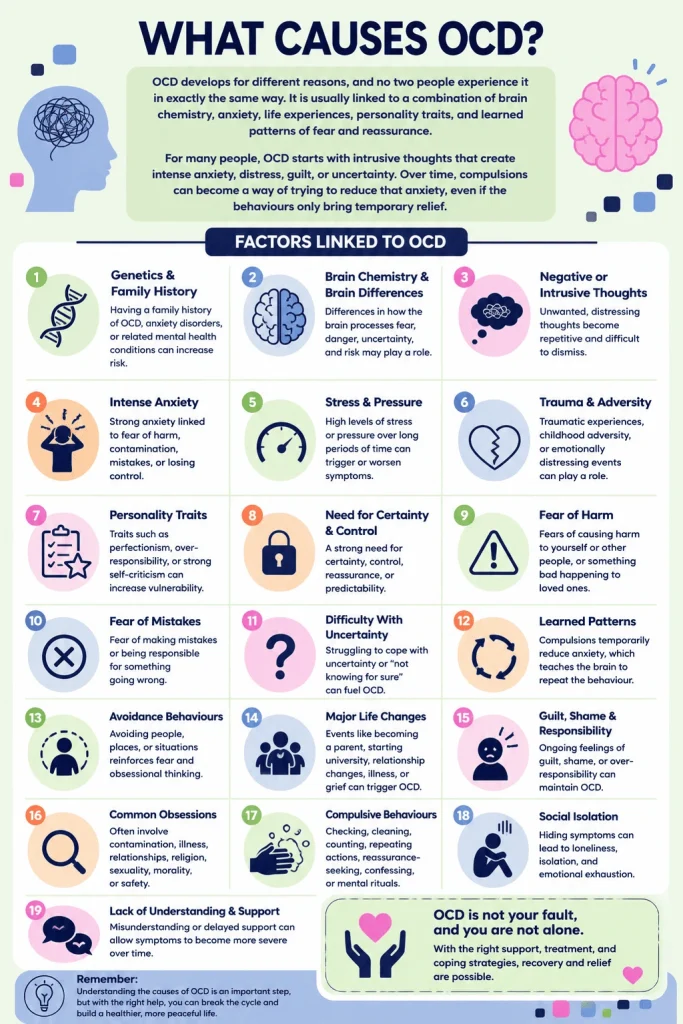
Common Factors Linked to OCD
- Genetics and family history of OCD, anxiety disorders, or related mental health conditions
- Differences in how the brain processes fear, danger, uncertainty, and risk
- Negative or intrusive thoughts that become repetitive and difficult to dismiss
- Intense anxiety connected to fear of harm, contamination, mistakes, or losing control
- High levels of stress or pressure over long periods of time
- Traumatic experiences, childhood adversity, or emotionally distressing events
- Personality traits such as perfectionism, over-responsibility, or strong self-criticism
- A strong need for certainty, control, reassurance, or predictability
- Fear of causing harm to yourself or other people
- Fear of making mistakes or being responsible for something going wrong
- Difficulties coping with uncertainty or “not knowing for sure”
- Learned behaviour patterns where compulsions temporarily reduce anxiety
- Avoidance behaviours that gradually reinforce fear and obsessional thinking
- Major life changes such as becoming a parent, starting university, relationship changes, illness, or grief
- Ongoing feelings of guilt, shame, or responsibility
- Common obsessions related to contamination, illness, relationships, religion, sexuality, morality, or safety
- Repetitive compulsions such as checking, cleaning, counting, repeating actions, reassurance-seeking, confessing, or mental rituals
- Social isolation or emotional exhaustion caused by trying to hide symptoms from others
- Lack of understanding or delayed support, which can allow symptoms to become more severe over time
For many people, OCD begins with intrusive or negative thoughts that feel disturbing, frightening, or “wrong.” Everyone experiences unwanted thoughts from time to time, but in OCD, these thoughts become stuck. Brain areas linked to fear, uncertainty, and danger can become overactive, making the thoughts feel urgent and impossible to ignore. This often creates intense anxiety, guilt, fear, or a strong need to feel certain or “safe.”
Common obsessions in OCD can include fears around contamination, harm, illness, mistakes, religion, relationships, sexuality, losing control, or something bad happening to loved ones. To reduce anxiety, people may begin compulsions such as checking, reassurance-seeking, cleaning, counting, repeating actions, avoiding situations, or mental rituals. While compulsions may bring temporary relief, the anxiety usually returns, keeping the OCD cycle going.
OCD and Co-Occurring Conditions
OCD can affect far more than repetitive behaviours or visible rituals. For many people, it exists alongside other mental health conditions, emotional difficulties, and overwhelming fears that are often hidden from others. Co-occurring conditions can influence how OCD develops, how symptoms appear, and how deeply it affects everyday life.
- OCD often exists alongside other mental health conditions such as anxiety, depression, PTSD, eating disorders, autism, ADHD, and body dysmorphic disorder
- Co-occurring conditions can make symptoms more intense, complex, and difficult to recognise
- OCD may develop gradually over time or appear during periods of stress, trauma, illness, or major life changes
- Intrusive thoughts can trigger obsessions that create intense anxiety, guilt, fear, or distress
- Compulsions are often used to reduce anxiety or prevent feared outcomes, even when the fears feel irrational
- Some people experience obsessive fears around contamination, harm, relationships, morality, religion, health, or losing control
- Personality traits such as perfectionism, hyper-responsibility, overthinking, and a strong need for certainty may be linked to OCD patterns
- Genetic, neurological, psychological, and environmental risk factors may all contribute to the development of OCD
- Trauma, chronic stress, bullying, family history of anxiety disorders, or unstable environments may increase vulnerability
- Many people with OCD feel ashamed or frightened by their intrusive thoughts and hide symptoms from others
- Fear of judgement or misunderstanding can delay people from seeking support or talking openly about their experiences
- OCD can affect relationships, education, work, daily routines, sleep, concentration, and emotional wellbeing
- Co-occurring mental health conditions may sometimes be recognised before OCD itself is identified
- Living with OCD can feel mentally exhausting, repetitive, isolating, and emotionally overwhelming
- Early understanding and the right support can help people manage symptoms and reduce the impact OCD has on daily life
OCD and Anxiety
OCD and anxiety are closely connected, but they are not the same condition. Anxiety is often a major part of OCD, especially when intrusive thoughts create fear, uncertainty, guilt, or a strong sense that something bad could happen. Compulsions may temporarily reduce anxiety, but the relief usually does not last long, causing the cycle to repeat again and again.
Many people with OCD live in a constant state of mental alertness, overthinking situations, checking for reassurance, or trying to prevent feared outcomes. Everyday situations can become emotionally exhausting when the brain constantly searches for danger, mistakes, or uncertainty. Over time, this can affect sleep, concentration, relationships, confidence, and overall wellbeing.
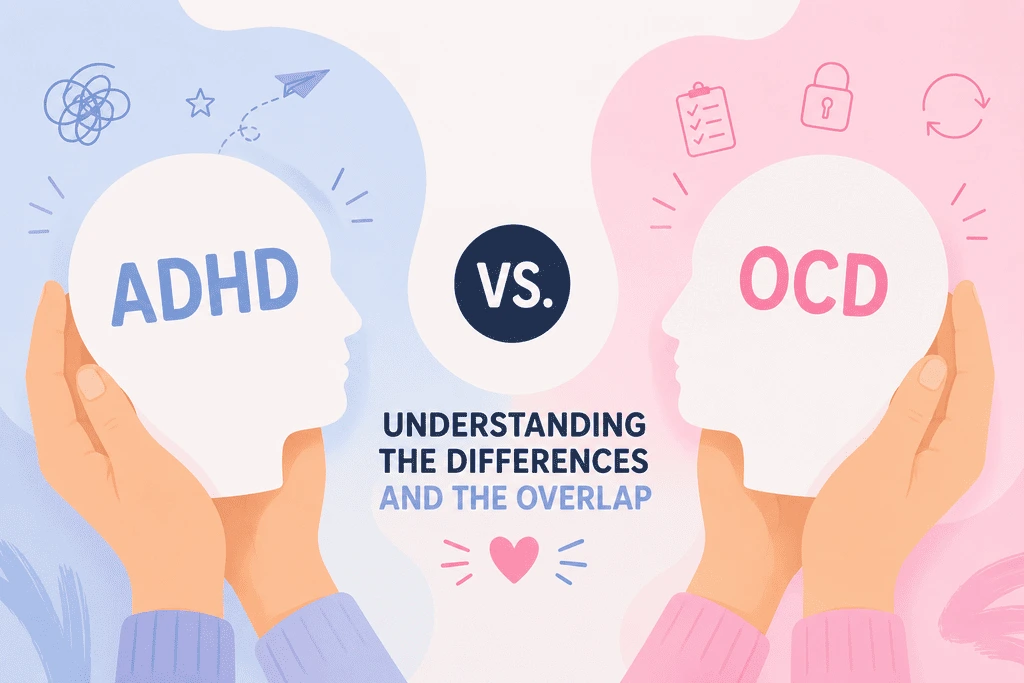
OCD and ADHD
OCD and ADHD can sometimes exist together, even though they may appear very different on the surface. ADHD is often linked to impulsivity, distractibility, emotional dysregulation, and difficulty organising thoughts or tasks, while OCD is more associated with repetitive thoughts, compulsions, and a strong need for certainty or control.
For some people, the combination can feel confusing and overwhelming. A person may struggle with racing thoughts, difficulty focusing, forgetfulness, and impulsive behaviours while also feeling trapped in repetitive mental rituals, checking behaviours, or obsessive fears. ADHD can also make OCD harder to manage, especially when concentration, routines, emotional regulation, and daily functioning are already affected.
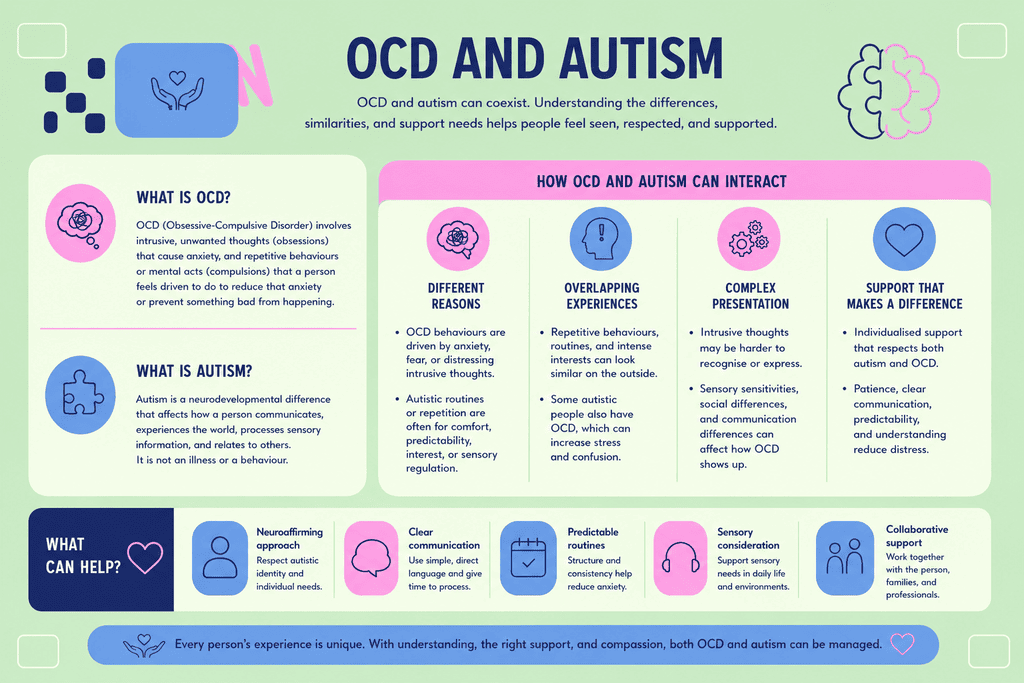
OCD and Autism
OCD and autism can sometimes overlap in ways that make diagnosis more complex. Repetitive behaviours, routines, sensory sensitivities, and intense interests may appear similar from the outside, but the reasons behind them are often different. In OCD, behaviours are usually driven by anxiety, fear, or distressing intrusive thoughts. In autism, routines and repetition may provide predictability, comfort, emotional regulation, or sensory stability.
Some autistic people also experience OCD separately, which can increase distress and emotional exhaustion. Intrusive thoughts, compulsions, and constant anxiety may become difficult to distinguish from existing routines or coping strategies. Understanding the difference is important because support needs to reflect the person’s experiences, communication style, sensory needs, and emotional wellbeing rather than relying only on visible behaviours.
OCD and Eating Disorders
OCD and eating disorders often share similar patterns linked to anxiety, control, intrusive thoughts, perfectionism, and repetitive behaviours. Some people experience obsessive fears around food, weight, contamination, body image, health, or routines connected to eating and exercise. These thoughts can become overwhelming and difficult to challenge.
For some people, eating-related rituals or restrictive behaviours may feel similar to compulsions, especially when they are used to reduce anxiety or create a temporary sense of control. OCD can also exist alongside conditions such as anorexia nervosa, bulimia, binge eating disorder, or avoidant restrictive food intake disorder (ARFID). When both conditions are present, emotional distress, shame, and isolation can become even more intense without the right understanding and support.
Treatment Options and Support
Living with OCD can feel exhausting. Many people spend hours trapped in obsessive thoughts, mental checking, reassurance seeking, avoidance, or compulsive rituals that temporarily reduce anxiety but keep the cycle going. Over time, OCD can affect sleep, relationships, work, education, confidence, and the ability to feel present in everyday life.
One of the hardest parts of OCD is that people often know their fears feel irrational, yet the anxiety still feels real, urgent, and impossible to ignore. This can lead to significant distress, shame, secrecy, and emotional exhaustion.
Common Treatment Options for OCD
Living with OCD can feel exhausting. Many people spend hours trapped in obsessive thoughts, mental checking, reassurance seeking, avoidance, or compulsive rituals that temporarily reduce anxiety but keep the cycle going. Over time, OCD can affect sleep, relationships, work, education, confidence, and the ability to feel present in everyday life.
One of the hardest parts of OCD is that people often know their fears feel irrational, yet the anxiety still feels real, urgent, and impossible to ignore. This can lead to significant distress, shame, secrecy, and emotional exhaustion.
Cognitive Behavioural Therapy (CBT)
CBT helps people understand how obsessive thoughts, fear, anxiety, and compulsive rituals become connected. It focuses on breaking the cycle rather than trying to “get rid” of thoughts completely.
Exposure and Response Prevention (ERP)
ERP is considered one of the most effective treatments for OCD. It involves gradually facing feared situations, thoughts, or triggers without carrying out compulsions or reassurance behaviours. Over time, the brain begins to learn that anxiety can reduce naturally without rituals.
Medication Support
Some people benefit from medication, which may help reduce the intensity of obsessive thoughts and anxiety. Medication is often used alongside therapy rather than as a standalone approach.
Important: Medications for OCD should only be prescribed, monitored, and adjusted by a qualified mental health specialist based on each person’s unique needs, symptoms, and medical history.
Specialist Mental Health Services
People with severe OCD may need support from a specialist mental health service, especially when symptoms involve extreme avoidance, intrusive thoughts, self-neglect, inability to leave home, or compulsions that take over large parts of the day.
Further Treatment and Intensive Support
When OCD does not improve with initial therapy, further treatment may include intensive outpatient programmes, community mental health support, trauma-informed therapy, occupational support, or inpatient care in more severe situations.
Online Support Groups and Peer Communities
OCD can feel very isolating, especially when intrusive thoughts involve taboo fears around harm, sexuality, religion, contamination, or relationships. Online support groups can help people feel understood without judgement and reduce the sense of being “alone” in the experience.
Support for Families and Carers
Families often become part of the OCD cycle without realising it through reassurance, accommodating rituals, or helping avoid triggers. Support and education can help carers respond in ways that reduce anxiety without reinforcing OCD patterns.
Mental Health Support and Community Transitions with Nurseline Community Services
Living with OCD can feel like being stuck in a constant battle with your own mind. Thoughts can become repetitive, frightening, or impossible to switch off, creating intense anxiety and an ongoing need to seek relief through compulsions, reassurance, checking, avoidance, or mental rituals. Even simple daily tasks can start to feel emotionally draining when the mind is constantly searching for certainty, safety, or control. At Nurseline Community Services, support starts with understanding how OCD affects the person behind the diagnosis and how these experiences shape everyday life.
For many people, OCD affects far more than visible behaviours. It can impact relationships, sleep, concentration, work, education, confidence, and emotional well-being. Some people experience overwhelming fears around harm, contamination, mistakes, or responsibility, while others struggle with intrusive thoughts that feel distressing, shameful, or difficult to talk about. Over time, living in a near-constant state of anxiety and mental exhaustion can leave people feeling isolated, misunderstood, or emotionally overwhelmed.
• Mental health nurses – supporting people through periods of heightened anxiety, intrusive thoughts, emotional distress, and compulsive behaviours while helping develop safer coping strategies and emotional regulation skills.
• Occupational therapy – helping people rebuild structure and confidence in everyday life through practical support with routines, sensory overwhelm, daily tasks, and independence.
• Trauma-informed support – recognising how long-term anxiety, past experiences, shame, or chronic stress may intensify obsessive fears, emotional distress, and self-critical thinking.
• Multimedia support – using creative and visual approaches to help people communicate thoughts, emotions, triggers, and behavioural patterns that may feel difficult to explain verbally.
• Recovery-focused support – providing therapeutic consistency, emotional reassurance, and personalised support to help people better understand their OCD, reduce distress, and improve quality of life.
Through personalised assessments and tailored care planning, support is adapted around each person’s experiences, strengths, challenges, and recovery journey. The aim is to help people feel safer, more understood, and more able to manage daily life with greater confidence and stability.
Contact us today or make a referral.
FAQs
Is OCD a form of Autism?
No. Obsessive-Compulsive Disorder and Autism Spectrum Disorder are different conditions, although some people may experience both at the same time. OCD is usually linked to intrusive thoughts and compulsions, while autism relates more to communication, sensory processing, routines, and how a person experiences the world.
How to stop OCD thoughts?
Trying to “force away” OCD thoughts often makes them feel stronger. Support usually focuses on learning how to respond differently to the thoughts, rather than fighting them. Treatments such as therapy, especially CBT with Exposure and Response Prevention (ERP), can help people reduce compulsions and manage anxiety linked to OCD.
What age does OCD usually start?
Obsessive-Compulsive Disorder can begin during childhood, adolescence, or early adulthood. Many people notice symptoms starting in their teenage years, although OCD can develop at any age.
What happens if OCD is left untreated?
Without support, OCD can become more overwhelming over time. Compulsions may take up more of the day, anxiety can increase, and daily life, relationships, education, or work may be affected. Some people also experience depression, isolation, or other mental health difficulties alongside OCD.