OCD in children means living with persistent anxiety caused by unwanted, intrusive thoughts and self-inflicted rituals that turn into obsessions. If these patterns are persistent for longer than one hour a day, or affect your child’s school, emotional and social world, this may be a sign of OCD.
Recognising OCD in children is not always easy, especially when it overlaps with ordinary, age-related patterns and behaviours.
OCD symptoms in children can take many different forms, and many parents can feel confused or sometimes even unsure whether or not they should ask for assessment or advice. Below, you can find a detailed explanation of what OCD in a child looks like, how to spot the first signs and how to provide the support your child needs.
Understanding Paediatric OCD: Obsessions vs. Compulsions
Obsessive-compulsive disorder (OCD) can develop at any age, but symptoms often first appear between 8 and 12 years old. Research suggests that OCD affects around 1–3% of children and young people. Childhood OCD can affect much more than a child’s behaviour. It can interrupt sleep, make everyday routines exhausting and turn simple activities, such as getting dressed or leaving for school, into stressful experiences. Unlike ordinary childhood worries, OCD involves recurring thoughts and rituals that cause significant distress or interfere with daily life.
What are obsessions in children?
Obsessions are recurring, unwanted thoughts, fears, images or urges. A child may worry that something bad will happen to their family, fear contamination or feel distressed when things are not arranged in a particular way. These fears can feel very real, even when there is little or no actual danger.
What are compulsions in children?
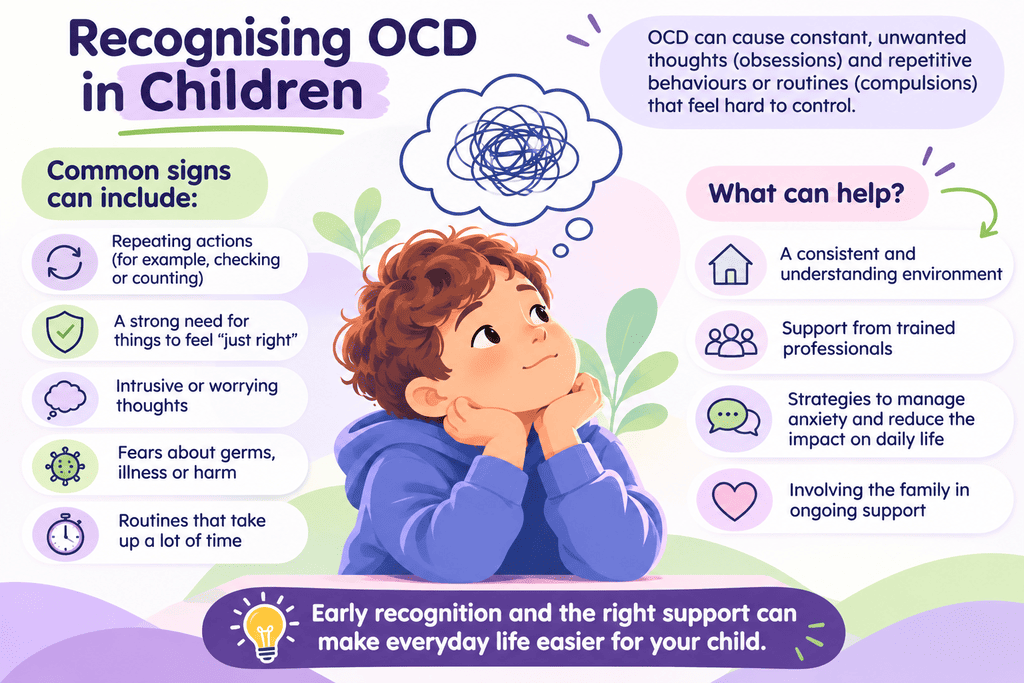
Compulsions are repetitive actions or mental rituals that temporarily relieve distress. Common examples include excessive handwashing, checking, counting, repeating words or constantly asking for reassurance. Although these behaviours may ease anxiety briefly, the fear often returns. This creates a cycle that can interfere with school, friendships, family life and everyday activities.
Common OCD Symptoms in Children
The early signs of OCD in children can be difficult to distinguish from typical childhood habits and worries. The difference often lies in how frequently symptoms occur, the distress they cause and how much they interfere with a child’s daily life. Symptoms may change over time and become more noticeable during periods of stress.
Common Obsessions in Children
Obsessions in children with OCD are unwanted thoughts, fears, images or urges that keep returning, even when the child tries to ignore them. Some children openly talk about their worries, while others keep them to themselves because they feel frightened, embarrassed or confused. Common repetitive behaviours include:
- Fear of harm: Worrying that a parent might have an accident or that something terrible will happen to someone they love.
- Contamination fears: Feeling unsafe after touching a door handle, sharing school supplies or sitting next to someone who is ill.
- Fear of making mistakes: Worrying that a small mistake at school could lead to serious consequences or harm someone.
- Need for symmetry or exactness: Feeling intense discomfort when shoes, toys or other objects are uneven or don’t look ‘just right’.
- Unwanted disturbing thoughts: Experiencing frightening images or thoughts about hurting someone, despite having no wish to do so.
- Fear of being a bad person: Worrying that an unwanted thought, a small lie or an accidental action means they have done something terribly wrong.
- Persistent doubt: Feeling unable to trust their memory, even after completing a familiar task correctly.
Common Compulsions in Children
Compulsions are actions or mental rituals children feel they must repeat to relieve distress, prevent a feared event or achieve a sense that something is ‘just right’. Some are visible, while others happen silently. Common compulsive behaviours include:
- Repeated reassurance-seeking: Asking ‘Are you sure you’ll be okay?’ several times, even after receiving a reassuring answer.
- Checking rituals: Repeatedly checking school bags, homework, doors or belongings because they cannot shake the feeling that something is wrong.
- Washing and cleaning: Washing hands until they feel clean enough, sometimes causing dry or irritated skin.
- Repeating everyday actions: Walking through a doorway again, putting on clothes repeatedly or restarting an activity until it feels right.
- Counting and silent rituals: Counting to a particular number, repeating phrases mentally or silently praying to prevent something bad from happening.
- Confessing and seeking forgiveness: Repeatedly telling parents about minor mistakes or unwanted thoughts to feel certain they haven’t done anything wrong.
- Arranging objects: Moving toys, books or school supplies until they reach a particular position or feel exactly right.
- Involving family members in rituals: Asking a parent to repeat certain words, answer questions in a specific way or follow particular routines to relieve anxiety.
A child or a young person may experience several of these symptoms at once, and the focus of their fears can change over time. The key difference between OCD and ordinary childhood habits is the distress, loss of control and disruption these experiences cause. A child who enjoys arranging toys is different from one who feels unable to leave the room until every toy is in exactly the right position.
How OCD May Appear at Different Ages
OCD symptoms can appear differently as children grow, depending on their age, emotional development and ability to express their thoughts. Younger children may struggle to explain their fears, while older children and teenagers may become more aware of their symptoms and try to hide them. As a result, the same underlying anxiety may show up through very different behaviours at different stages of childhood.
OCD in Younger Children
Many younger children with OCD struggle to understand or explain their unwanted thoughts and fears. Instead, their anxiety may appear through everyday behaviours, such as:
- Repeating actions: Doing something over and over until it feels ‘just right’.
- Following strict routines: Becoming distressed when someone changes the order of familiar activities.
- Seeking reassurance: Asking the same questions repeatedly, even after receiving an answer.
- Strong emotional reactions: Becoming upset, frustrated or overwhelmed when someone interrupts a ritual.
Younger children may not understand why they feel compelled to repeat these actions. They simply know that completing them helps reduce anxiety, even if the relief lasts only a short time. This can make OCD difficult to distinguish from typical childhood habits or behaviours.
OCD in Older Children and Teenagers
As children grow older, they may become more aware of their obsessive thoughts and compulsive behaviours. Many feel embarrassed, confused or afraid of being judged, so they try to hide their symptoms from family members and friends. OCD in older children and teenagers may appear through:
- Perfectionism and repeated checking: Rewriting homework, checking messages or reviewing mistakes long after completing a task.
- Intrusive thoughts: Experiencing unwanted thoughts about harm, relationships, morality or other sensitive topics.
- Mental rituals: Silently counting, repeating phrases or mentally reviewing past conversations to reduce anxiety.
- Avoidance: Staying away from certain people, places or activities that trigger obsessive fears.
- Reassurance-seeking: Repeatedly asking whether they have done something wrong or upset someone.
Teenagers may spend considerable time managing these thoughts and rituals without anyone noticing. Some recognise that their fears are excessive but still struggle to resist compulsions. Over time, OCD can affect concentration, school performance, friendships and independence.
How OCD Differs from Typical Childhood Behaviours
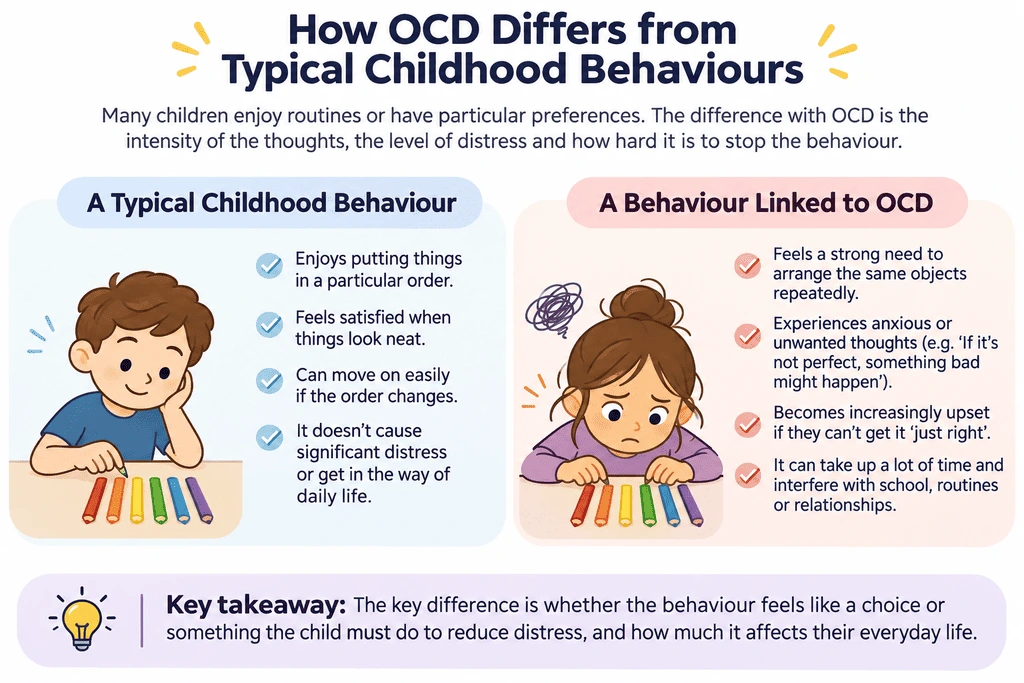
Many children develop habits, enjoy routines or go through phases of worrying about certain things. The difference with OCD lies in the distress and urgency behind these behaviours. While other children can usually move on when a routine changes, children with OCD may feel unable to stop because obsessive thoughtscreate intense anxiety or a fear that something bad might happen.
For example, a child may enjoy putting things in a particular order because they like being organised. A child with OCD, however, might spend a long time arranging the same objects repeatedly, feeling increasingly distressed if they cannot get them ‘just right’. The key difference is whether the behaviour feels like a choice or something the child must do to relieve distress, and how much it interferes with everyday life.
What Does OCD Look Like in a Child’s Everyday Life?
Childhood OCD can appear in ordinary situations, making it difficult for parents and teachers to recognise what’s happening. A child may seem distracted, upset or unwilling to cooperate, while actually struggling with unwanted thoughts or an overwhelming need to complete a ritual.
Here are some everyday examples of how OCD may affect children:
- Getting ready for school: A child puts their socks on and takes them off repeatedly because they don’t feel ‘right’. What should take five minutes turns into half an hour of frustration and tears.
- Saying goodbye to a parent: Before leaving for school, a child asks their mum, ‘Will you be okay?’ several times. Even after hearing ‘yes’, they worry something terrible might happen while they’re apart.
- Completing homework: A child erases and rewrites the same sentence repeatedly, despite getting it right the first time. They feel unable to move on until the writing looks or feels exactly right.
- Playing with friends: A child suddenly stops playing after an unwanted thought about hurting a friend. Frightened by the thought, they avoid the game, even though they have no intention of hurting anyone.
- Getting ready for bed: A child insists that their parent repeats the same goodnight phrase in a particular order. If a word changes, they become distressed and ask to start again.
- Sitting in the classroom: A child silently counts or repeats certain words in their mind to prevent something bad from happening. Their teacher notices they aren’t concentrating, but cannot see the mental ritual.
These examples show why OCD in children can be mistaken for behavioural difficulties, perfectionism or ordinary childhood anxiety.
How is OCD Assessed in Children?
If you notice repeated behaviours, unusual fears or worries that interfere with your child’s daily life, start by speaking to your GP. They can discuss your concerns and, if needed, refer your child to a specialist children’s mental health service, such as CAMHS in the UK.
- Recognising the signs at homeYou may notice repeated questions, checking, unusual routines or distress when your child cannot complete certain actions. Make a note of what happens and how often.
- Visiting your GPExplain what you’ve noticed, when it started and how it affects your child. Your GP can consider other possible causes and discuss a referral.
- Meeting a mental health specialistA specialist will talk with you and your child about their fears, repeated doubts and compulsive actions, including behaviours such as keeping objects because they fear throwing them away.
- Understanding your child’s needsThe specialist will consider your child’s age, normal development and how their symptoms affect school, sleep and family life. They may use an assessment tool such as the CY-BOCS.
- Agreeing on the next stepsIf your child has OCD, the specialist will explain the findings and discuss suitable treatment, usually cognitive behavioural therapy (CBT) with exposure and response prevention (ERP), adapted for children.
Remember: Children may feel embarrassed or frightened to describe their thoughts. You don’t need to know whether your child has OCD before asking for help. Sharing what you’ve noticed is a good place to start.
The Role of Community Complex Care at Home
Cognitive behavioural therapy (CBT), particularly exposure and response prevention (ERP), is the recommended first-line treatment for children with OCD. However, children with more severe OCD may also need additional support with daily activities, attending school and staying connected with friends and their community.
In this case, continuous and honest communication between home and school is essential.
Early access to personalised care at home, alongside specialist treatment, can help children practise coping strategies in everyday situations, gradually face specific fears and reduce compulsive rituals. With consistent support, children have more opportunities to regain independence, build confidence and enjoy the activities that are part of growing up.
Supporting Children with Complex Mental Health Needs
When a child struggles with OCD, it’s easy for everyday life to revolve around their fears, rituals and appointments. Early recognition and the right treatment can help change that. But while we focus on helping children manage their difficulties, we must also make sure they don’t miss out on being children.
What about the child who loves football but is too anxious to join a team? Or the talented young artist who spends hours repeating a drawing because it never feels right? Their interests and abilities are still there, even when OCD makes it difficult to enjoy them. The right support should help children overcome specific fears and rituals while encouraging their talents, building on their strengths and giving them more opportunities to do what they love.
Personalised At-Home Care Strategies
Small changes at home can help children with OCD manage anxiety, build confidence and enjoy everyday activities. Through consistent routines, family support and collaborative care, families and care teams can put practical strategies into action alongside specialist treatment.
- Getting ready for school => Consistency & Routine: A child spends 30 minutes choosing clothes because nothing feels right. Their family follows a predictable morning routine and gradually helps them reduce the time spent on rituals.
- Enjoying family meals => Managing Anxiety: A child avoids sitting at the table because they’re afraid of germs. With guidance from their therapist, they practise joining family meals through small, manageable steps.
- Making time for hobbies => Building Independence: A child loves painting but keeps starting over until every detail looks perfect. Their support team helps them finish a picture without repeating the activity.
- Helping parents => Family Support: A child repeatedly asks their mother to check the front door. Through family therapy, parents can learn how to respond with reassurance and warmth without participating in compulsive rituals.
- Supporting learning => Collaborative Care: A child struggles to complete homework because they repeatedly erase answers. Families, teachers and care teams work alongside NHS Child and Adolescent Mental Health Services (CAMHS) to follow consistent strategies at home and school.
These personalised strategies should support the child’s individual CBT and exposure and response prevention (ERP) treatment plan, helping them gradually face fears and reduce compulsions.
It is also important to offer reassurance without reinforcing compulsive behaviours.
Why Children May Hide OCD Symptoms?
Children and young people with OCD may feel embarrassed or feel scared to talk about their thoughts and behaviours. Some worry that others will find their fears strange, laugh at them or misunderstand what they’re experiencing. They may hide repeated checking, counting or even hoarding objects because they don’t know how to explain why they feel the need to do these things.
A child may appear fine at school but struggle for hours at home. They might avoid certain daily activities, secretly repeat rituals or become upset when someone throws away objects they’ve been keeping. Recognising these less visible signs can help families understand what their child is going through and encourage them to talk without fear of judgement.

Mental Health Support with Nurseline Community Services
What happens when therapy ends for the day, but OCD continues to affect your child’s everyday life?
Even when OCD is treated following a diagnosis, a person with OCD may still need additional support to cope with obsessions and compulsions at home, at school or in the community. Having the right people around them can make everyday situations easier.
Nurseline Community Services can help you with:
Support where your child feels most comfortable
We provide care at home and in the community, getting to know your child’s routines, interests, fears and what helps them feel safe.
Experienced people who understand complex needs
Our care teams can draw on the knowledge of Positive Behaviour Support (PBS) specialists and Community Psychiatric Nurses (CPNs) to understand distress and respond to each child’s needs.
Your family is part of every decision
We listen to your concerns, respect your child’s wishes and work alongside their mental health professionals to provide consistent support.
One example is a child who loves gymnastics but avoids training because of OCD-related fears. Our care team can work alongside their therapist and family to help them gradually return to the activity they enjoy.
Because progress can mean something as simple as enjoying a birthday party, going to football practice or leaving the house without fear, deciding the day.
For more information on how we can support you or a loved one, contact us today!
FAQ
At what age can OCD start in children?
Obsessive-compulsive disorder (OCD) can develop at any age, including early childhood. Symptoms commonly appear between ages 8 and 12, although some children show signs earlier.
Can childhood OCD be managed at home?
Yes. Children with OCD can benefit from support at home alongside specialist treatment, particularly cognitive behavioural therapy (CBT) with exposure and response prevention (ERP). Parents can help by following agreed treatment strategies, reducing involvement in compulsive rituals and supporting daily routines.
Can a child have OCD without visible compulsions?
Yes. Some children experience mental compulsions, such as silently counting, repeating words or reviewing thoughts, which others cannot see. These hidden rituals can cause significant anxiety and interfere with daily activities.
Can autism and OCD occur together?
Yes. Autistic children can also have OCD. Although repetitive behaviours may occur in both, OCD compulsions typically aim to reduce anxiety or prevent feared outcomes. A specialist assessment can help distinguish between OCD symptoms and autism-related routines or interests.