


Despite advances in healthcare, people living in the most deprived parts of the UK still experience shorter lives, spend many more years in poor health, face higher rates of preventable illness and death, and often have poorer access to timely healthcare services.
To help address these longstanding inequalities, a place-based approach emerged as a way of recognising that health outcomes are shaped by where people live, work, learn, and connect with others. Rather than applying a one-size-fits-all model, it focuses on understanding the unique needs and strengths of local communities and developing coordinated, locally driven solutions.
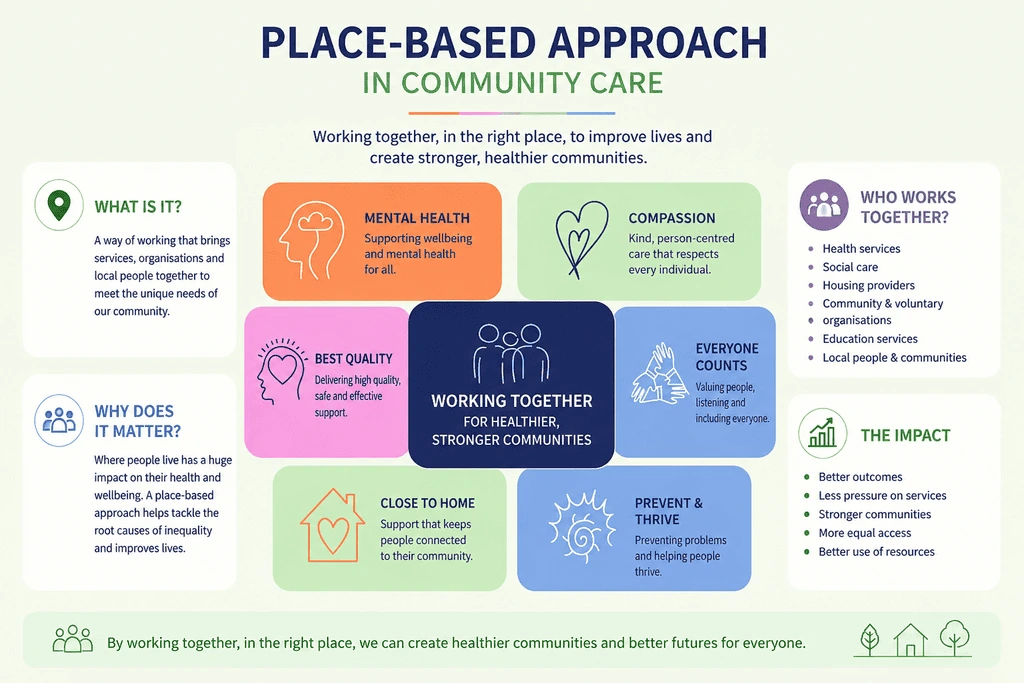
A place-based approach is a collaborative way to improve outcomes by tailoring support, services, and resources to the unique needs and assets of a local area and its residents. It focuses on delivering services tailored to the specific needs of a community, considering the local context, culture, and resources available.
Health Inequalities and Why Place-Based Approach Matters
Health inequalities refer to the unfair and avoidable differences in health outcomes between different groups of people, often linked to deprivation, geography, ethnicity, disability, and access to healthcare.
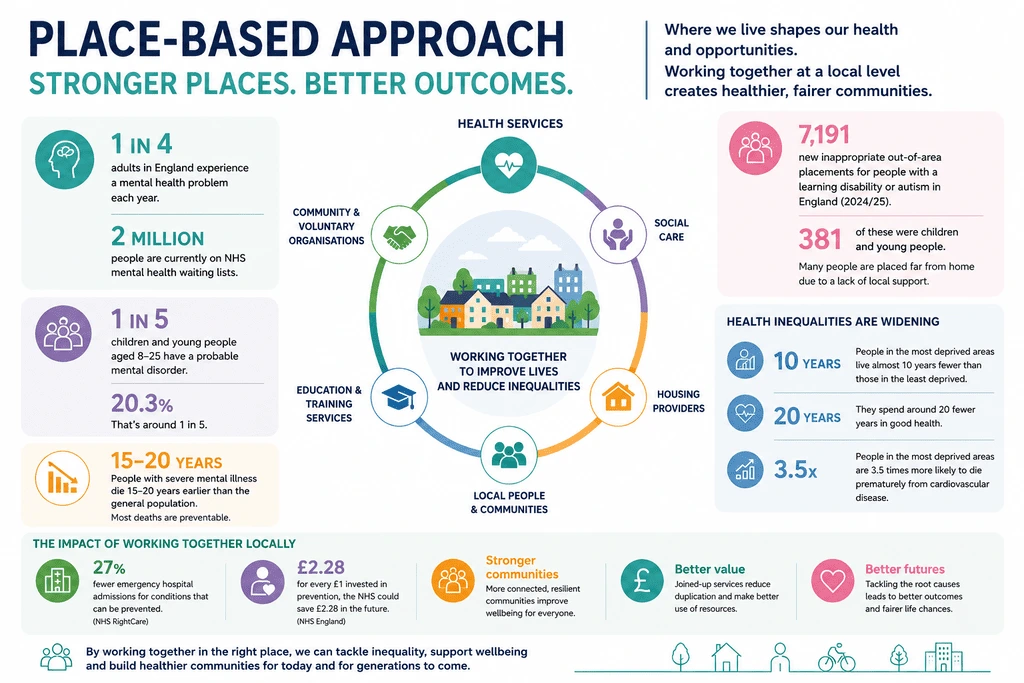
People living in the most deprived areas of England have a life expectancy nearly 10 years lower than those in the least deprived areas.
Health inequalities arise from a combination of factors, including socioeconomic conditions, access to services, and broader environmental determinants that vary between communities. These inequalities mean that certain population groups experience poorer health outcomes than others.
Healthy Life Expectancy
- People in the most deprived areas can expect to spend almost 20 fewer years in good health than those in the least deprived areas.
- In England, the healthy life expectancy gap is now around 19.4 years for males and 20.3 years for females between the most and least deprived communities.
People with learning disabilities are almost twice as likely to experience health complications from preventable causes compared with the general population.
People living in the most deprived communities are significantly more likely to experience mental health challenges, with common mental health disorders around 74% more prevalent than in the least deprived areas.
Out-of-Area Placements (OAPs)
Out-of-area placements occur when people are placed in inpatient or residential services far from their home community because suitable local support is unavailable.
Mental Health
Despite national commitments to reduce inappropriate placements, thousands of people continue to receive care away from home each year.
Being placed far from home can:
- Increase isolation from family and support networks.
- Disrupt continuity of care.
- Delay recovery and discharge.
- Increase the likelihood of restrictive practices.
Learning Disability and Autism
In England’s annual OAP data for 2025:
- 7,191 new inappropriate out-of-area placements were recorded.
- 381 involved children and young people.
Many people remain in placements because local housing, community support, or specialist services are unavailable.
Why This Matters for Place-Based Working
Place-based approaches aim to develop local housing, community support, crisis services, and integrated care pathways that help people remain close to home and avoid unnecessary institutional or distant placements.
How Place-Based Approach Can Tackle Health Inequalities
A place-based approach recognises that people’s health and wellbeing are influenced by where they live, work, learn, and access services. Rather than focusing only on healthcare, it brings together organisations such as the NHS, local authorities, housing providers, education services, voluntary organisations, and communities to address the wider factors that affect health.
Why Was It Developed?
Traditional services often worked in silos, making it difficult to address the root causes of poor health. Research consistently showed that:
- People in deprived areas experience worse health outcomes.
- Health inequalities are strongly linked to factors such as housing, employment, education, transport, income, and social connections.
- Healthcare alone accounts for only a portion of overall health outcomes.
As a result, policymakers began promoting place-based approaches to:
- Reduce health inequalities.
- Improve population health.
- Tackle the wider determinants of health.
- Coordinate services around local needs.
- Strengthen community resilience and participation.
How Does It Reduce Health Inequalities?
A place-based approach focuses on the specific challenges within a local area, for example:
- Poor housing conditions.
- Social isolation.
- Unemployment.
- Limited access to healthcare.
- Lack of community support.
- Higher rates of long-term conditions.
Instead of delivering separate interventions, organisations work together to create joined-up solutions tailored to that community.
UK Policy Context
The concept became increasingly prominent through:
- NHS England population health management programmes.
- Integrated Care Systems.
- The Local Government Association and NHS guidance on place-based partnerships.
- The Marmot Review, which highlighted the impact of social determinants on health inequalities.
What is a Place-Based Approach In Community Care?
For decades, health and social care services have often responded to people’s needs in isolation. Healthcare focused on treatment, social care focused on support, housing addressed accommodation, and community services worked separately again. Yet people’s lives do not fit neatly into these systems.
A person’s health is shaped by far more than the care they receive. Factors such as housing, employment, education, social connections, transport, and access to local services all play a significant role in determining health and wellbeing. This is particularly evident in communities experiencing higher levels of deprivation, where people are more likely to face poorer physical and mental health, reduced life expectancy, and barriers to accessing support.
A place-based approach emerged from the recognition that improving outcomes requires more than delivering individual services. It focuses on understanding the unique needs, assets, and challenges of a specific community and bringing organisations together around a shared goal: supporting people to live healthier, safer, and more independent lives.
Rather than asking how a single service can respond to a problem, a place-based approach asks what a community needs to thrive and how health, social care, housing, education, voluntary organisations, and local people can work together to achieve it. By addressing the wider determinants of health and building support within communities, place-based approaches aim to reduce inequalities, strengthen local resilience, and enable people to receive the right support in the right place at the right time.
Key Elements of a Place-Based Approach
- Understanding the unique needs of a local community.
- Working collaboratively across health, social care, housing, and voluntary services.
- Focusing on prevention and early intervention.
- Supporting people closer to home and within their communities.
- Reducing health inequalities and improving access to support.
- Involving local people in decisions about services and support.
This method encourages collaboration across sectors, including healthcare, social services, local councils, and community organisations, fostering local partnerships to deliver more effective, community-centred approaches.
The goal is to ensure that decisions about service delivery are made as close to the community as possible, often through local oversight and community engagement. By leveraging local knowledge and empowering communities to take an active role in their wellbeing, place-based approaches can lead to positive outcomes such as reducing health inequalities and improving populations’ overall health and wellbeing.
Key Principles
A place-based approach is guided by several key principles that empower communities, decentralise decision-making, and foster collaboration across sectors. These principles ensure that local communities can actively shape the services they receive while also addressing the wider determinants of health holistically and sustainably.
Community Integration
Community integration is at the heart of the place-based approach. It emphasises the importance of involving local residents, organisations, and stakeholders in the planning, designing, and implementing health and care services. By fostering a sense of ownership and collaboration, community-led initiatives ensure that services are better tailored to meet the local needs of specific population groups. This strengthens the connection between local communities and service providers and enhances the long-term sustainability of health interventions by ensuring they are rooted in the reality of people’s everyday lives.
Engaging community members in decision-making can lead to more culturally appropriate and relevant interventions, which improves the likelihood of achieving positive outcomes such as improved health and wellbeing. Community integration also allows local organisations to leverage local resources and develop solutions that address the underlying causes of health inequalities.
Integration of Services
Effective place-based partnerships require integrating health and social care services to ensure seamless, person-centred care. By breaking down silos between different sectors, such as healthcare, housing, and economic development, the integration of services leads to more coordinated care. This holistic approach addresses clinical needs and social factors, such as housing and employment, that influence health outcomes.
Integrated services also promote efficiency by reducing duplication and improving communication between providers. By bringing together local authorities, healthcare providers, and community organisations, integrated care systems (ICSs) can better meet the complex needs of their communities, leading to more equitable health outcomes and enhanced population health.
Localised Decision-Making and Resource Allocation
A key principle of place-based working is decentralising decision-making and allowing communities to have more control over the allocation of resources. By shifting power from national systems to local authorities and partnerships, resources can be directed where they are most needed based on each local area’s specific challenges and opportunities. This enables a more responsive and flexible approach, ensuring that funding and services reflect the community’s unique needs, from improving public health to addressing local health inequalities.
Localised decision-making is vital in addressing disparities between regions and population groups. By prioritising resources for areas with the greatest need, this approach can help reduce health inequalities and improve overall community health. Additionally, local authorities and organisations are better positioned to understand the immediate needs of their populations, allowing them to create targeted interventions that address local circumstances.
How to Implement a Place-Based Approach
A place-based approach works best when organisations understand local needs, work together, and adapt support based on what communities need most.
Step 1: Map Local Demographics & Needs
Start by gathering local data and listening to communities. Identify health inequality hotspots, service gaps, and social factors affecting people’s health, such as housing, employment, and income.
Step 2: Build Multi-Sector Partnerships
Bring together healthcare providers, local councils, social care teams, housing services, and community organisations. Shared knowledge and joined-up working help create more effective support systems.
Step 3: Design Targeted Interventions
Develop solutions based on local priorities rather than using a universal model of care. Direct resources where they will have the greatest impact and set clear goals to measure success.
Step 4: Monitor & Adapt
Track outcomes, gather community feedback, and review local data regularly. Use these insights to refine services and respond to changing needs over time.
Creating Health and Social Services Tailored to Community Needs
Creating health and social services that meet the specific needs of a community requires a deep understanding of the local context and the challenges its population faces. A place-based approach focuses on tailoring services to address the unique circumstances of different communities, recognising that centrally designed solutions are often ineffective. By prioritising local knowledge and involving local communities in the planning process, services can be designed to reflect the realities of people’s lives, from economic and social factors to environmental and health-related concerns. This ensures that interventions are more relevant and responsive to the needs of the people they serve.
For services to be effective, they must also be integrated across different sectors. This involves bringing together health, social care, housing, and even education and employment services, ensuring that all aspects of wellbeing are addressed.
Ultimately, tailoring services to community needs reduces disparities in access and care. By fostering community engagement local partnerships, local authorities and service providers can work together to co-produce sustainable solutions to reduce health inequalities over the long term. This collaborative approach leads to more equitable outcomes, ensuring that everyone, regardless of their background, has access to the care and support they need.
Multidisciplinary Teams Working Within Communities
Place-based approaches depend on multidisciplinary teams (MDTs) because no single service can address the complex factors that influence people’s health and wellbeing. Health professionals, social workers, housing teams, public health specialists, and community organisations work as part of a wider network, sharing responsibility for improving outcomes within a local area.
This joined-up model allows services to look beyond immediate health needs and respond to the challenges that often sit behind them, including poor housing, unemployment, social isolation, and poverty. Instead of delivering fragmented support, MDTs help create coordinated responses that reflect the realities of the communities they serve.
In areas experiencing higher levels of deprivation, MDTs can identify local priorities, target resources more effectively, and ensure support reaches the people who need it most. This makes services more responsive, reduces inequalities, and strengthens community wellbeing over the long term
Improved Health Outcomes
A place-based approach helps improve health outcomes by ensuring support is shaped around the needs of local people rather than a standardised model of care. This allows services to identify challenges earlier, intervene sooner, and provide support that is more relevant and accessible to the communities they serve.
By working towards shared goals, health, social care, housing, and community services can prevent issues from escalating and help people access the right support at the right time. This often leads to better physical and mental health, fewer crises, reduced hospital admissions, and improved quality of life.
The approach also supports outcomes-based care by focusing on the results that matter most to people. Rather than measuring success by the number of services delivered, it focuses on achieving meaningful outcomes such as greater independence, improved wellbeing, and reduced health inequalities.
Place-Based Approach With Nurseline Community Services
At Nurseline Community Services, we understand that no two communities are the same. The challenges people face, the support available to them, and the factors affecting their wellbeing can vary significantly from one area to another. That is why we use a place-based approach to ensure the support we provide reflects the realities of the communities where people live.
Working alongside local authorities, healthcare professionals, housing providers, and community organisations allows us to build support around each person’s circumstances, goals, and local environment. Whether someone requires mental health support, help transitioning from hospital to community living, or assistance accessing local services, we focus on creating solutions that are practical, personalised, and connected to the resources available in their area.
This work is strengthened by our internal multidisciplinary team, which includes Community Psychiatric Nurses (CPNs), Positive Behaviour Support (PBS) specialists, Registered General Nurses, support workers, and other health and social care professionals. Together, our teams provide clinical oversight, specialist assessments, behavioural support, and personalised care planning, ensuring people receive coordinated, outcome-based support that helps them remain safe, stable, and independent within their communities.
For more information, contact us today or make a referral.